
“Borgo Italia has become an important presence for the local community, for Italians living here, for those who love Italy, and for those seeking authentic Italian cuisine”
Intervista di Desirè Sara Serventi
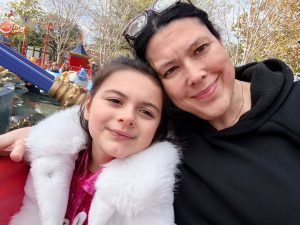
After working in the aviation industry, Cristiana Folchitto became a restaurateur in America, where she opened the restaurant Borgo Italia in Senoia, Georgia. Her story traces the transition from a professional path connected to flights and travel to a venture built with passion around authentic Italian cuisine. Sledet.com spoke with Cristiana Folchitto, who shared her story.
You decided to leave Italy, move to America, and open an Italian restaurant. Can you tell us what led to that decision?
Actually, my journey began long before the restaurant was founded. I initially came to America on my own; my mother joined me a couple of years later. In Italy, I worked for Delta Air Lines and earned a degree in aviation. My story therefore began with a connection to the world of aviation, travel, and the international dimension that has been part of my life since I was young.
Was your family professionally connected to America?
Yes. Both my mother and father worked for two major American companies. My mother first worked for Pan Am and then for Delta Air Lines for more than forty years, while my father worked for Opel. When I was a child, the future I imagined for myself naturally revolved around that world: aviation, airports, flights, and contact with people from all over the world. It was a reality that was part of our everyday life.
Who passed on to you a love for America?
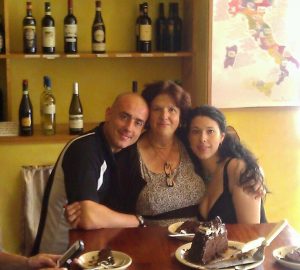
Without a doubt, my mother, both to me and to my brother. From the time we were children, she instilled in us this love for the United States, telling us about America as the land of opportunity, a place where work, commitment, and merit could truly change a person’s path in life.
When you began working, were you always in contact with Americans?
Yes. Working for Delta Air Lines, I was in contact with Americans every day, and it was during that period that I realized it was the place where I wanted to live. That does not mean I do not love Italy; on the contrary, I deeply love my country. I had a great-uncle who lost his life during the war in Africa and received a gold medal for military valor for Italy. My brother, Alessandro, served for eighteen years in the military, in the Special Forces, as a captain. My grandfather served Italy as an officer, but chose to retire when the Germans arrived because he did not want to fight alongside them. We are a family that is extremely proud of its roots and deeply connected to our country. At the same time, however, America has always represented the land of opportunity for me.
When did you decide to leave Italy?
At the age of 29, I decided to take the big leap. I told myself that I wanted to try pursuing this American path and see what would happen. Sometimes in life, there comes a moment when you feel you have to take a risk, and I understood that this was the risk I needed to take. I come from a family accustomed to thinking big, with discipline, sacrifice, and a sense of duty.
So you left everything behind and left?
Yes. I arrived in America on a five-month tourist visa. I can say that I fell in love with the area, the people, the atmosphere, and the way of life. It is a completely different world from Italy. Here, we are in a small American community, the classic small town where everyone knows one another, people are kind, and there is still a strong sense of community. Coming from Rome, I felt the contrast enormously. In Rome, I often had the feeling that many things did not work: the management of the city, cleanliness, and certain public services. You pay taxes and wonder where they end up. The same applies to healthcare: you pay taxes, but then you may have to wait a long time for an appointment or an examination.
Can you tell us how you came to Senoia, Georgia?
I came directly here to Senoia with my mother because we already knew the area and wanted to buy a house. At first, we stayed here for a short period, then we returned to Italy. After a couple of months, I came back on my own and stayed to get to know the place better, organize everything, and build this new life.
How was the Borgo Italia restaurant born?
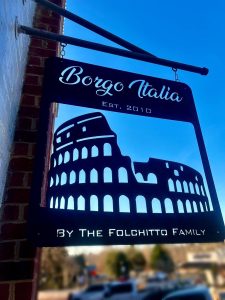
Here in Senoia, practically everyone knows one another. People who knew me started saying, “Why don’t you open an Italian restaurant?” They had tasted my dishes, prepared according to my grandmother’s recipes, and they kept encouraging me to turn that passion into a real business.
And then?
So I said, “Let’s give it a try.”
You did not have experience in the restaurant industry, correct?
Exactly. We came from completely different worlds, but there has always been a strong sense of business and organization in my family. We have always been used to facing challenges with discipline, sacrifice, and a sense of duty. We have never been afraid of change.
What did you actually do?
We literally created this business from scratch. We created the restaurant’s name, menu, theme, organization, and every detail needed to build something of our own. Today, after sixteen years, Borgo Italia has become an important presence for the local community, for Italians living here, for those who love Italy, and for those seeking authentic Italian cuisine. I can say that Borgo Italia was born precisely from this: from an idea, from the desire to change our lives, from the decision to come to America, and from the will to build something that represented us.
Did the rest of your family join you afterward?
My mother was the first to arrive, after retiring. Then my brother Alessandro arrived; he left his brilliant military career in the 9th Parachute Assault Regiment “Col Moschin” to pursue a career in the film industry. Finally, my father joined us.
Was your mother very important to Borgo Italia?
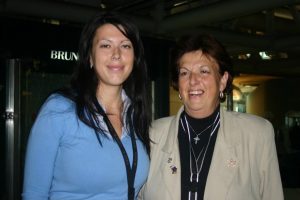
Very much so. I opened Borgo Italia, but my mother, who sadly is no longer with us, was the real driving force behind the restaurant and much more. Ever since I was a child, she passed on to us her love for the United States. She introduced us to this country, brought us here when we were young, allowed us to attend summer camps, and gave us experiences that enabled us to learn the language, get to know American culture, and develop a relationship with this reality. She was the one who planted in us that seed which, over the years, became the desire to build our lives here.
What is the main experience for someone entering Borgo Italia for the first time?
For anyone who enters my restaurant, the main experience is just one: entering Italy. They are not simply walking into an Italian restaurant in America. They are entering a place that seeks to tell the story of our country.
What do you mean by that?
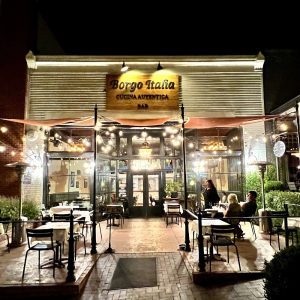
I mean that everything is designed to convey a piece of our culture. Our menu is written in Italian, with explanations in English, but the language of the restaurant is Italian. On the walls there are photographs of Italy taken by my father, who is also a photographer. Our wines are exclusively Italian, as are most of the products we use. What we want to convey above all is heart: bringing a piece of Italy to the heart of Georgia.
Are the chefs Italian?
Of course. Our chefs are Italian.
What is the nicest compliment you receive from your customers?
The nicest compliment is when, after eating, they tell me, “We felt as though we were on vacation in Italy.” And that is exactly what we want to create. People hear Italian being spoken, ask questions about Italy, and tell us about their trips to our country and the emotions they experienced there. It is an experience they can hardly find elsewhere, because Borgo Italia is run by real Italians: people who grew up in Italy and came here as adults, with cultural and culinary backgrounds they experienced firsthand. We are not simply people of Italian descent who were born and raised in America. I want everyone who comes in here to feel as though they are in Italy. And that also means educating their palate.
What do you mean by that?
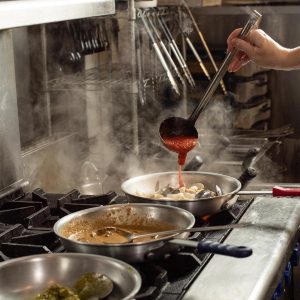
I mean that we had to carry out a genuine process of gastronomic education. When we started, many people were used to spaghetti and meatballs or Alfredo pasta. We explained that these are not authentic dishes from the Italian tradition and that, even when something similar exists in our cuisine, the preparation and the concept are completely different. Over time, we succeeded in helping people understand the value of true Italian cuisine, and we built a customer base that has followed us for years precisely because it seeks authenticity. We explained that genuine Italian cooking does not come from ready-made sauces, but from dishes prepared fresh. It uses quality extra-virgin olive oil, real cheeses, selected meats, and prosciutto imported from Italy. That is where the difference lies.
Do all of your products come from Italy?
Most of our products come from Italy, while a small portion is local, especially fruit and vegetables, because they are fresh and perishable products. However, I want to emphasize one thing: we prepare a great many products directly in the restaurant.
Which ones, specifically?
We import flour from Italy and make all of our fresh pasta ourselves. We prepare bread, desserts, focaccia, and pizzas. We have a master baker who is responsible for this area, because for us quality begins with the basics. That is what makes the difference.
Were you the first to bring authentic Italian cuisine to Senoia?
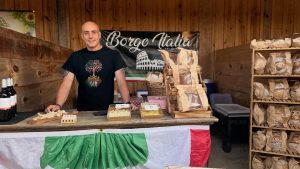
Yes, certainly in our area. There are other Italian restaurants run by people who came from Italy and opened businesses here. There are also several in Atlanta, and some are truly excellent, but in Senoia and the surrounding areas, we were the first to bring authentic Italian cuisine, with Italian products and a philosophy genuinely connected to our traditions.
What can you say about innovation in the kitchen?
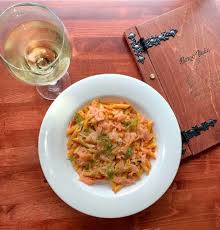
Cuisine naturally evolves. The presentation of dishes changes, as does the visual language and the way food is told through presentation. Even in Italy, the dishes you once saw in restaurants are now presented differently. There has been the influence of nouvelle cuisine, minimalist styles, and new forms of plating. The plate itself has changed. In the past, pasta was served on the classic round plate; today, you can find it on square or elongated plates, or presented in a nest shape. Presentation certainly plays an important role in modern dining.
Have you ever compromised on dishes to adapt to American tastes?
We are an authentic Italian restaurant, but we are also a business that has to thrive, so we need to find a balance. If a family comes in that has been to Italy, loves our cuisine, and wants to eat Italian food, but has a small child who wants Alfredo pasta, we make it for them. We do not say, “This dish does not exist, it cannot be made.” If someone wants spaghetti and meatballs, we do not turn them away; we make it for them, joking that it is not an authentic Italian dish, but that it can still be good. It is a compromise with local taste, without giving up our identity.
You said that you have Italian chefs in the kitchen. Can you tell us more about them?
Yes, my chefs are Italian. One comes from Northern Italy, specifically Trento, and the other is from Milan. However, our cuisine aims to represent all of Italy, because our country is made up of extraordinary regional traditions. For this reason, our menu includes dishes from different areas: from Sicily to Campania, from Northern to Central Italy. We have many Roman dishes, such as amatriciana and carbonara. From Sicily, we offer puttanesca and swordfish. We have tried to take the best from the different regional traditions and bring it together in one menu, selecting dishes that represent our gastronomic culture and are also appreciated by our customers. The same philosophy applies to our wines. We want to tell the story of Italy through its different regions.
Where do your wines come from?
We have wines from Sicily, Sardinia, Piedmont, Veneto, and Tuscany. They come from all over Italy, because the world of wine also tells the story of the richness and diversity of our country.
What criteria do you use to choose the dishes to include on the menu?
In the restaurant business, you always start with an initial menu, then you have to observe customers’ behavior: understand what is ordered most often and what does not appeal to the public. A remarkable dish will not necessarily find its place right away. Take linguine with squid ink, for example: perhaps two people order it, while others may not feel comfortable with the black color of the pasta because they do not know the ingredient or associate it with something strange. But I grew up in Ostia, by the sea, and for me everything related to fish is natural. It is part of my culture. So, over time, we made selections based on what customers liked most, without losing our identity.
Which dish best represents Borgo Italia?
Certainly, our homemade fresh pasta. Among our best-selling dishes are porcini mushroom ravioli, lobster ravioli, and gnocchi with gorgonzola and walnuts. We are particularly proud of these dishes because we make them completely from scratch, from the pasta to the sauces. We use Italian flour and, for customers with celiac disease, we also import gluten-free flour from Italy. We prepare pasta, bread, and desserts for them, always strictly homemade. This is one of the things that sets us apart most.
What does Italian cuisine represent to you?
Italian cuisine is authenticity.
What do you mean by that?
I mean that you must respect the quality of the ingredients and the foundations of our tradition. You cannot compromise when it comes to flour, extra-virgin olive oil, and fundamental products. We select many of the ingredients we use for our signature dishes directly from Italy. At the same time, when we find excellent-quality local products here in Georgia, we use them without any problem. The important thing is to respect the execution and the foundations of Italian cuisine; otherwise, you are not in front of a real Italian restaurant, you are in front of an Italian-American restaurant.
Are your dishes the same as those found in restaurants in Italy?
To be honest, there are some dishes on our menu that in Italy are normally found more often in homes than in restaurants. Lasagna is one of our best-selling dishes, but it is not always found in a traditional Italian restaurant. You may find it in a trattoria or in places more connected to home-style cooking, but it is not necessarily a dish available everywhere. Here, however, it is very successful because those who come to us do not have the same culinary heritage that we Italians have.
What is the difference between the perception of food in Italy and in America?
For us Italians, food is not just nourishment. It is not simply a matter of saying, “Let’s go out for dinner.” Food is culture; it is love for the land and respect for what the land produces. It is a moment for family, sharing, and togetherness. Here in America, society is often faster-paced. Americans eat out very frequently, even every day, for both lunch and dinner. In Italy, people generally go out to dinner once a week, and when they sit down at the table, they stay there for hours because they want to experience that moment. Here, on the other hand, some people may arrive, eat quickly, and immediately ask for the bill, because that culture of long conviviality at the table is missing. Of course, we also have customers who love to enjoy dinner slowly, but the relationship with food is different.
So how did you try to convey this culture?
You have to adapt, but at the same time you have to tell the story. We have tried to make people understand the value of sitting at the table and enjoying food, wine, and company. Over sixteen years, we have made enormous progress in communicating that food is not merely something to consume, but an experience to live.
At your restaurant, do you also look out for people who are struggling?
Yes, we do a great deal of charity work, and this is one of the things I am most proud of. Outside the restaurant, we have a sign that says that if a person is in a difficult situation and is hungry, they can come in, order a pasta dish and a dessert, and simply say that it should be put on the neighborhood’s tab. No one will ask questions. In this way, a person in need, together with their family, can have a meal without having to pay and, above all, without having to explain their situation to anyone. For me, it is essential that no one should feel humiliated when they need help. The most beautiful thing is that many people come in, eat, pay their bill, see that sign, and tell me, “I want to contribute to this fund too.” It is a simple gesture, but it says a great deal about our community. It is a gesture toward a stranger, and one day that stranger may do the same for someone else. That is how kindness begins. Once it starts, it becomes a movement that is impossible to stop. Here in Senoia, no one turns their back on others.
Is this your personal initiative?
No, and I care deeply about saying this. The United States is an extremely generous country. People are willing and ready to help. This is my way of giving something back to the community that welcomed me and made me feel part of it.
Is there a particular moment in your life connected to this sense of community?
Yes. There is one specific moment. My mother became ill, and I stayed with her from the time she entered the hospital until the end of her journey. I never left her. During that time, I was not physically present at the restaurant because I was by her side, but our customers and our community offered their help for free. Some cleared tables, some brought food, and some helped at the register. They were people who simply came to lend a hand, without asking for anything in return. That, to me, is what community means. It means knowing that you are not alone.
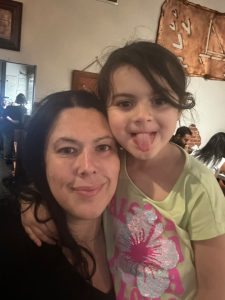
Who is Cristiana when she is not busy at the restaurant?
Cristiana, before being the owner of the restaurant, is Sofia’s mother. That is my most important role. Sofia is my blessing. I am also a basketball coach at my daughter’s school and I carry out several humanitarian activities. I am also part of my church group. In my life, I do not complain about anything. I consider myself a privileged person. I have a home, my daughter is wonderful and healthy, my brother is the best brother I could ever have, my father, thank God, is well, and the restaurant is doing well. Every morning, I thank the Lord. Of course, everyone has their own problems, but I believe it is important to have a broader view of the world and not look only at one’s own little garden. If we compare ourselves with many situations around the world, we realize how privileged we are.
What are your plans?
I would like to open a new venture connected to Borgo Italia: an authentic Italian pastry shop in this area. It is a project we have been working on for quite some time, partly because we wanted to wait until we found the right person. We have finally managed to bring a pastry chef here from Italy: he has worked in Dubai and Monte Carlo, and has won international awards in the world of pastry-making. This is very important to us because we want to bring not only Italian flavor to Georgia, but also the professionalism, technique, and tradition of Italian pastry-making. We are also considering the possibility of expanding Borgo Italia into other areas of Georgia and perhaps other states as well. We want to continue telling the story of Italy through food, while always maintaining the same values: quality, authenticity, and passion.
Would you like to add anything else?
Yes. I want to say that I love Italy, I love Rome, and I love my roots. Italy will always remain a part of me. My family, my story, and my culture belong to that country. My story is precisely about this: building a bridge between two countries that I love deeply. And what can I say Borgo Italia was born for this reason, because Italy is not just a place; it is a way of living, of being together, of loving food, family, and people. And that is what we try to share here every day, in the heart of Georgia, in Senoia.
Sledet.com thanks Cristiana Folchitto for the interview, and ad maiora!